




FAQ Glossary Block
1. Increased Efficiency: Automation solutions can revolutionize the logistics process by eliminating the need for manual tasks, resulting in increased efficiency in the supply chain.
2. Cost Savings: By reducing labor costs, increasing accuracy, and reducing errors, businesses can save money and reinvest it into other areas of their operations.
3. Improved Customer Service: With real-time visibility and tracking of inventory and shipments, businesses can respond quickly to customer inquiries and provide accurate delivery times.
4. Increased Flexibility: With automation solutions, businesses can respond quickly to changes in demand, supply chain disruptions, and other factors that can impact the logistics process.
5. Enhanced Visibility: Automation solutions provide real-time visibility and tracking of inventory and shipments, enabling businesses to make informed decisions and optimize their logistics operations.
1. Demand forecasting: Accurate demand forecasting is critical for retail logistics management to avoid stock-outs or overstocking. Retailers must also manage inventory levels to optimize sales and minimize losses from overstocking or understocking. However, the retail industry's complex supply chains can make it challenging to manage relationships with multiple suppliers, manufacturers, distributors, and retailers and ensure the timely delivery of goods.
2. Transportation costs: Transportation costs associated with moving products from suppliers to stores can also be a challenge for retailers. Managing delivery schedules and negotiating rates with carriers is essential. Additionally, customers expect fast and accurate delivery of products, which puts pressure on retailers to offer efficient logistics operations.
3. Reverse logistics: Reverse logistics is another significant challenge for retail logistics management. Retailers must manage the process of returns, repairs, and refurbishment of products, which can be time-consuming and costly. Implementing and managing logistics technology, such as warehouse management systems and transportation management systems, is essential to improve efficiency and accuracy.
4. Sustainability: retailers must consider the environmental impact of their logistics operations and implement sustainable practices, such as reducing packaging waste and using eco-friendly transportation methods.
What are the specific applications of hai robotics?
Hai robotics focuses on R&D and design of its ACR system, realizing independent R&D of core elements such as robot body, basic positioning algorithm, control system, robot scheduling.
Smart warehouse management system, and owns numerous global patents.
- All
- A
- B
- C
- D
- E
- F
- G
- H
- I
- J
- K
- L
- M
- N
- O
- P
- Q
- R
- S
- T
- U
- V
- W
- X
- Y
- Z
ACR refers to an autonomous robot designed to handle and transport cases or containers within a warehouse or distribution center without the need of human intervention. These robots are equipped with advanced sensors, artificial intelligence, and navigation capabilities to autonomously navigate through the facility, pick up and drop off cases, and optimize the movement of goods. ACRs are commonly used to automate repetitive and labor-intensive tasks such as order fulfillment, inventory replenishment, and material handling.
AGV stands for Automated Guided Vehicle, which refers to a self-operating mobile robot used for material handling and transportation tasks within a controlled environment such as a warehouse or manufacturing facility. These vehicles are equipped with various sensors, navigation systems, and control technology to navigate through predefined paths or use real-time data to dynamically plan their routes. AGVs are commonly used to transport goods, pallets, or other materials between different locations, reducing the need for manual labor and improving efficiency.
Hairou has set up multiple spare parts warehouses all over the country, managed by special personnel, and can provide customers with comprehensive spare parts services in a timely and rapid manner, fully covering customer needs.
Hairou has set up multiple spare parts warehouses all over the country, managed by special personnel, and can provide customers with comprehensive spare parts services in a timely and rapid manner, fully covering customer needs.
AS/RS stands for Automated Storage and Retrieval System, which refers to a computer-controlled system used for automatically storing and retrieving goods or materials from a designated storage area. AS/RS typically consists of racks or shelving units, automated cranes or shuttles, and a central control system. These systems utilize advanced software and hardware components to manage inventory, track locations, and optimize storage and retrieval operations. By automating these processes, AS/RS systems enhance efficiency, accuracy, and space utilization in warehouses or distribution centers.
Yes, it can
Yes, HaiPick supports customization within a certain range.
The HaiPick can operate for approximately 6.5 hours after being fully charged.
The maximum straight movement speed of the robot is based on full load.
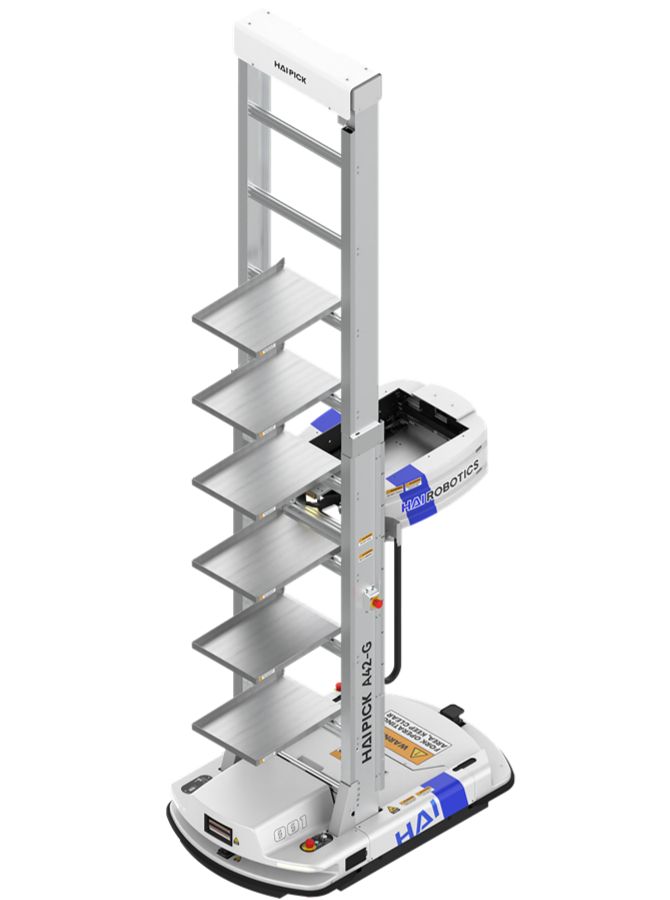
The HAIPICK A42 is the ACR (autonomous case-handling robot), independently developed by HAI ROBOTICS. It can realize intelligent picking, storage and simultaneous handling of multiple cases (up to 300kg on a single trip).
As a new intelligent logistics handling device, HAIPICK A42 can realize intelligent moving in the warehouse without the help of any track. It has the functions of autonomous navigation, active obstacle avoidance, and autonomous charging
HAI ROBOTICS is the pioneer and leader in autonomous case-handling robot systems. The company is committed to providing efficient, intelligent, and flexible automation solutions through advanced robotics and AI algorithms creating value to every warehouse and factory.